Tuesday, November 28, 2006

Fingered

I recently represented Gun Free South Africa at a workshop organised by the CSIR. They are working on a vast research project that will examine violence in South Africa and hopefully impact on policy well into the future.

We were asked to share our ideas about what a safe and secure South Africa might feel / look like.

One response was: “Survive Alive”

Another: “You watch a little girl riding on a bicycle and a butterfly flits past. You have time to watch the butterfly because you are not worried about the little girl.”

Someone said they want to live in a society that has open doors and where her own front door is unlocked.

I thought about the “New Jerusalem” in Revelation. The image is one of a city built out of precious stones. Walls built with diamonds, rubies and the like would be beautiful, transparent and still functional. For me, that is my dream for SA; I look forward to the day when the structures of our society are life affirming (beautiful), not sinister (transparent) and work efficiently (functional).

Which raises a question (amongst others) of why Home Affairs needs my fingerprints when I apply for an ID book? What purpose does it serve to have my fingerprints?

Home Affairs says that its system is separate from the police (and I assume intelligence services) and is not used for finding people whose prints turn up on crime scenes. The HA fingerprints are used exclusively to establish the unique identity of each person.

But, by its own admission, HA is rife with corruption. It is relatively easy to procure an identity document. Apparently the manual system for storing and acquiring fingerprints is partly to blame for the ease with which crooks are selling fake identities. Why will a more complicated system change this necessarily? What is about fingerprints and computers that will make it harder for people to fake and steal identities any more than say, photographs or retinal scans?

Furthermore, while it is not impossible that two people with the same name could be born on the same day in the same place, surely the odds are stacked hugely in favour of this information creating a reasonably discreet individual identity without the hassle and expense of maintaining a technology intensive electronic fingerprinting archive.

Is the current system efficient? No. Will a new computerised be more efficient? Yes, but at what expense?

Is the system life affirming? No – taking my prints makes me feel like a criminal.

Is the system transparent? No. I think there are undeclared interests at play. At best, somebody stands to benefit from the investment in the new technology for a fingerprint database while holding out the carrot of incorruptibility. At worst, the assurance that fingerprints are used only for identification purposes is a lie.


Monday, November 27, 2006

Christ the King

Read John 18:33-37

Christ the King is a relatively new festival in the church year. Its roots go back only to the late 1800's, when the world's great empires - British, American, Spanish, French, German, Russian, Japanese - were all at war or about to go to war somewhere. After World War I, in 1925, Pope Pius XI designated the last Sunday in October as Christ the King Sunday. The Second Vatican Council moved Christ the King Sunday to the last Sunday of the church year.

It is fitting that this year the festival coincides with the “16 days of activism” against domestic violence.

In the published diaries of Joseph Goebbels, the infamous Nazi Propagandist, there are a few references to Mahatma Gandhi his contemporary. Goebbels believed that Gandhi was a fool and a fanatic. If Gandhi had the sense to organize militarily, Goebbels thought, he might hope to win the freedom of India. He was certain that Gandhi couldn’t succeed following a path of non-violent direct action. Yet as history played itself out, India peacefully won her independence while the Nazi military machine was destroyed. What Goebbels regarded as weakness actually turned out to be strength. What he thought of as strength turned out to be weakness.

The same ideological differences characterised the contemporaries of our Bible story today. In this courtroom drama we have Pilate and Jesus sparring in a life and death struggle with words that ring out over history. One wonders if anyone - save perhaps Jesus - grasped the magnitude of that battle.

For sure, we often assume that Jesus was misunderstood, and indeed he was. But one person understood Jesus only too well. It is for this reason that Pilate allowed Jesus to be executed. He knew without a doubt after this duel of words that Jesus was dangerous to everything that the Roman Governor was tasked to protect.

Like Gandhi, Jesus refused to use the methods of Pilate and of Goebbels. Jesus’ way – a method which Gandhi incidentally learned from – was far more powerful than any military empire. It is a method that to this day is not fully appreciated nor understood.

Jesus’ method excludes all other methods. It cannot be adopted as one strategy amongst many, as one arrow in a quiver of tactics. It requires total allegiance. One cannot love one’s enemy and plot against them at the same time.

Jesus’ method is all consuming. It cannot be applied to only one area of one’s life. To have compassion on only one’s friends and family while ignoring the plight of the rest of the world is not compassion but self-interest.

Jesus’ method is ultimately powerful. Assume it, and you may very well lose your life. Reject it, and authentic life will forever be beyond your grasp. Jesus method is so radically new it requires the end of life as we know it and the creation of something so radically new we cannot imagine it from any “old-life” perspective. It is for this reason we celebrate Christ as King at the end of the Christian year – for we acknowledge that everything comes to an end in Christ’s new beginning.

All of this is quite apocalyptic and rightly so. Jesus framed his theology in an apocalyptic mindset. He saw his adventure on this earth as heralding the end of time but let us not confuse Jesus’ apocalyptic with the sensationalised Armageddon of modern doomsday prophets ala Hal Lindsay, “Left Behind” and co.

Jesus’ method did not and does not predict or require the end of the earth, only the end of the world. There is a difference. The earth is “good” (Genesis) and so is all life on it. The covenant with Noah guaranteed that God would never again cause the destruction of earth. Where such destruction is happening today, it is human fault, not God’s design. Jesus’ method does require that the systems of the world come to an end and for the past two thousand years that process has been ongoing. Dictatorships and empires have crumbled and democracies are rising, global efforts to redress poverty have mobilised, prejudice is being dismantled from our systems of governance as well as our hearts and more and more revolutions are won through non-violence rather than sword or gun.

The world – as it once was - is ending.
The world – as it once was - is ending. The earth rejoices.
The earth rejoices.

This is not to say that we don’t still have a long way to go. Poverty and war have seen their premium century in the last hundred years, as has prejudice. But there is a global consensus and a global ability, for the first time in history that has the potential to end human suffering. That consensus is gaining strength, not losing strength.

Christ the King Sunday reminds us that we are called to celebrate the Reign of God that is arriving and has arrived all over the world. Wherever Christ’s Reign is being made manifest, let us add our voices and efforts to the furtherance of compassion, justice and freedom for all people.

Pilate has reason to be nervous. So should all modern powers, especially those that in any way impinge on human dignity and freedom for Christ will Reign over all.

Oh, and here's an interesting riddle...

Axe to grind?

In the sidebar, you'll see I have a link to "The Axle". I'm part of the coffee-holics support group that started it and we're trying to create a space for Christians to encounter fresh ways of engaging their faith in South Africa and the world. So if you think there is something that could help us get a debate going let us know.

The latest post I've copied here:

Mother Theresa always said, “Calcuttas are everywhere – if only we have the eyes to see. Find your Calcutta.” I was ready to come home. I knew that my Calcutta was the United States. For I knew we could not end poverty until we took a careful look at wealth. ... I learned from the lepers that leprosy is a disease of numbness. The contagion numbs the skin, and the nerves can no longer feel as the body wastes away. In fact, the way it was detected was by rubbing a feather across the skin and if the person could not feel it, they were diagnosed with the illness. To treat it, we would dig out or dissect the scarred tissue until the person could feel again. As I left Calcutta, it occurred to me that I was returning to a land of lepers, a land of people who had forgotten how to feel, to laugh, to cry, a land haunted by numbness. Could we learn to feel again?

Shane Claiborn, The Irresistable Revolution. (after a stint of serving in a leper colony in Calcutta.)

In South Africa, we have Calcutta and the US living next door to each other. We are one of the few countries where such poverty and wealth are so proximate. We do not have the luxury of geographic distance. So our collective numbness seems even more stark.

Check out "The Axle"

Tuesday, November 21, 2006

Creed

"I am well aware that I don't get to decide who God is. What I do get to decide, however, is to whom I pledge my allegiance. I am a free agent, after all, and I have standards for my God, the first of which is this: I will not worship any God who is not at least as compassionate as I am."

Want to find out more: read this article.

Yabonga

Some of you will remember my post about Yabonga getting robbed and the threat that this posed to the ongoing work of their voluntary counselling and testing site. Yabonga have decided to keep the site open, although they have taken steps to increase security. Below is a letter from Yvette.

From: Yvette Andrews
Sent: 17 November 2006 02:04 PM
To: Greg Andrews
Subject: Yabonga

Hi Love
Please send this to your dassie list esp those who wrote after the robbery.

XX

Hi
A while ago we had an armed robbery and Greg wrote asking for support for us at Yabonga while we found our feet again.

It is now months later and as I write this I have a background choir of Yabonga women practising their songs for World Aids Day.Listening to these women singing 'Never give up ' I wanted to write to all of you who supported us initially after the robbery to thank you for your prayers and emails - those messages sustained us at a time when Yabonga felt like a scary place
rather than the refuge that it normally is for so many of us.

I also wanted to say as we approach World Aids Day that Yabonga has overcome the various challenges thrown at it this year and not only have we survived but we have grown as individuals and as an organisation. It is because of this we can approach WAD with gladness in our heart and truly say we have discovered how to live positively with HIV.

However none of this would have been possible with out the love and support of friends. We understand that our success is largely due to the support we receive and this support enables us to reach out to others.

So from the bottom of Yabonga's heart - Thank you , Dankie , Enkosi and may you have a blessed World Aids Day..

Yabonga
2 Main Rd Wynberg
Tel : 021 761 2940
Fax : 021 761 3407

Wednesday, November 15, 2006

Finding God in the Busyness

Jurgen sent me this article. The idea of finding God in busyness is central to my own theology. Of course too much busyness is unhealthy, but as the author of the article suggests, busyness is life and God is there too. This is particularly important for people in urban settings where busyness envelopes one, even when one is still. There are a thousand messages streaming at one through advertising, newspapers, sounds and activity. There are as many threats, both to one's sense of self as to one's health. To remain focussed on what is precious and life-giving is challenging but it can be done.

Fuzzy Wuzzy

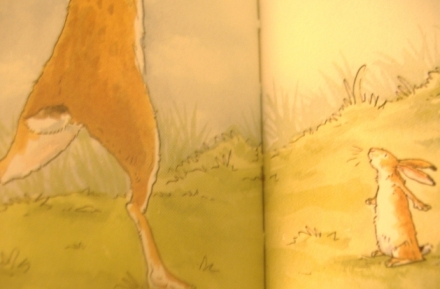
I picked up one of Katie’s books – one I’d not read yet. I read it to Katie and it touched me, which is a measure of just how much hormones affect Dad’s too. It’s called “Guess how much I love you” by Sam McBratney and illustrated by Anita Jeram. Here it is…

Little Nutbrown Hare, who was going to bed, held on tight to Big Nutbrown Hare’s very long ears. He wanted to be sure that Big Nutbrown Hare was listening. “Guess how much I love you,” he said.

“Oh, I don’t think I could guess that,” said Big Nutbrown Hare.

“This much,” said Little Nutbrown Hare, stretching out his arms as wide as they could go.

Big Nutbrown Hare had even longer arms. “But I love you this much,” he said.

Hmm, that is a lot, thought Little Nutbrown Hare.

“I love you as high as I can reach,” said Little Nutbrown Hare.

“I love you as high as I can reach,” said Big Nutbrown Hare.

That is quite high, thought Little Nutbrown Hare. I wish I had arms like that.

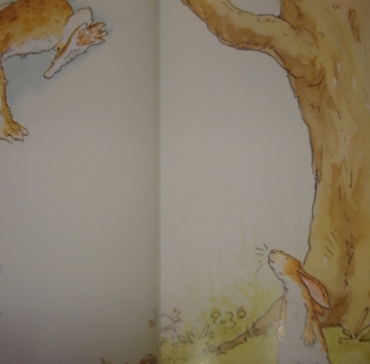
Then Little Nutbrown Hare had a good idea. He tumbled upside down and reached up the tree trunk with his feet. “I love you all the way up to my toes!” he said.

“And I love you all the way up to your toes,” said Big Nutbrown Hare, swinging him up over his head.

“I love you as high as I can hop!” laughed Little Nutbrown Hare, bouncing up and down.

“But I love you as high as I can hop,” smiled Big Nutbrown Hare – and he hopped so high his ears touched the branches above.

That’s good hopping, thought Little Nutbrown Hare. I wish I could hop like that.

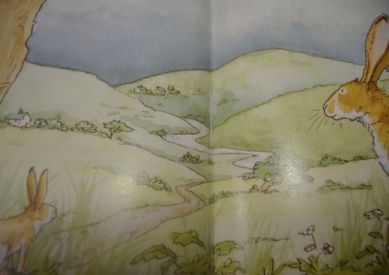
“I love you all the way down the lane as far as the river,” cried Little Nutbrown Hare.

“I love you across the river and over the hills,” said Big Nutbrown Hare.

That’s very far, thought Little Nutbrown Hare. He was almost too sleepy to think any more. Then he looked up beyond the thorn bushes, out into the big dark night. Nothing could be further than the sky.

“I love you right up to the moon,” he said, and closed his eyes.

“Oh, that’s far,” said Big Nutbrown Hare. “That is very, very far.”

Big Nutbrown Hare settled Little Nutbrown Hare into his bed of leaves. He leaned over and kissed him good night. Then he lay down close by and whispered with a smile, “I love you right up to the moon – and back!”


Friday, November 10, 2006

President Katie unfazed by recent Senate upset

Make a meal of it

Mom sent me this link which I enjoyed very much. Don't worry, the pasta is wheat free.

Monday, November 06, 2006

Nuf Sed

A dangerous man who faded away has finally died. I hope he is enjoying a nice cup of rooibos tea with Steve Biko. Too early as yet methinks, but at least Steve is enjoying it.

My abiding memory of PW Botha was an interview conducted by journalists outside his Wilderness residence during the Truth and Reconciliation Campaign. He was saying his usual stuff about how the TRC was maligning his name and his people and that he would have nothing to do with it, blah, blah, blah…

Behind him in the background was the driveway to his house, “Die Anker”, which is Afrikaans for “The Anchor”. There is a sign at the bottom of the driveway with this name on it. There is a graphic on the sign of an anchor lying on its side with the words arranged around it. The end hooks of the anchor which form a “W” shape lie next to the word “Anker” so that the net result is a sign which says:

Die Wanker

As PW wagged his finger at the world, his own home silently and unwittingly condemned him. What I found funny then, I find sadly prophetic now. I expect that there will be many deaths in the years to come which will be just as sad because one more chance at reconciliation will die with each recalcitrant, narcissistic and unrepentant soul.

In this context it is good to remember Vlok’s recent penitence at the feet of Frank Chikane (and a few others that didn’t make the media spotlight, mind you). While it doesn’t go far enough, it was immeasurably better than nothing.

History is the quintessential reality-defined-by-perception. PW has condemned himself to an eternity of bad jokes and piercing satire. Vlok has created a paradoxically hopeful as well as confounding position – one that will be debated but never pitied.

Sunday, November 05, 2006

Sermon - living faith

Following Bill Loader’s lead this week, I imagine here a conversation between Jesus and a less sympathetic Scribe than the one who confronts Jesus in Mark 12: 28-34. First, read Mark’s version.

Scribe: “So Jesus, which commandment is the first of all?”

Jesus: “Love the Lord your God with all your heart, soul, mind and strength.”

Scribe: “Mmmm…”

Jesus: “And the second is this: love your neighbour as yourself. There isn’t a commandment greater than these.”

Scribe: “Oh really?”

Jesus: “Yes, these are greater than any law, more important than whole burnt offerings and sacrifices.”

Scribe: “Well, I don’t know about that. Surely if one loves God, one will obey all God’s commands? These include sacrifices and burnt offerings, not to mention much besides.”

Jesus: “Absolutely, but they are all subordinate to devotion.”

Scribe: “Perhaps, but on what basis is ‘love of neighbour’ second? Surely all of God’s commands are second? The ‘love of neighbour’ is but one of many.”

Jesus: “God’s command to love is one, just as God is one. ‘Hear Oh Israel, the Lord our God, the Lord is one.’ All commands - all law - are subordinate to the nature of God, subordinate to love.”

Scribe: “Are you suggesting we should stop making sacrifices?”

Jesus: “There is no need for sacrifice for love fulfils the law. Law was created to regulate human relations and love perfects those relations.”

A conversation between modern Christians reminiscent of this conversation between Jesus and the Scribe, might go like this:

“How can you accept homosexuality? Don’t you follow the Bible?”

“No, I don’t. I follow Jesus. I read the Bible”

Today is called “All Saints Day” in the liturgical calendar. It is a day we recall the people who have died in the past year as well as the saints of old who have rooted us in the faith. One of these saints is John Wesley.

Whereas Jesus gave to us the principle of interpreting scripture through the eyes of love, Wesley gave us a method to do this.

For Methodists the Bible is but one of four sources for theology and ethics. The Bible is to be read in tension with Reason, Tradition and Experience. This amounts to a wrestling for truth, but never a pronouncement of truth. Our decisions are always contingent upon new information. And this is why we speak of faith for certainty has no place in this struggle. This is why we speak of our religion as ‘living’ and that Jesus is alive – for we follow a man who still walks in surprising directions, shifting the goal posts, wily and unpredictable.

After Jacob deceived his brother and left his family he slept one night, no doubt troubled by his past and searching for direction. During that night God came to him and they wrestled with each other. In the morning, Jacob was more resolute, but still bore the mark of having wrestled with God. Our faith is like that. We wrestle with God and each other to discern a truth that propels us to action.

Tuesday, October 31, 2006

"What big ears you have, Grandma!"

Little Red Riding Hood meets the Big Bad Wolf dressed in her grandma’s nightgown and lying in her bed. She says to Wolf-dressed-as-Grandma, “My, what big ears you have, Grandma!”

“All the better for hearing you, my dear” replies Wolf, “All the better for hearing you.”

Will big ears improve my hearing?

When I was 25 I wore a size 7 comfortably. Now at 35 I prefer a size 8. At this rate I will be resorting to stokies in my 80’s - if I last that long. From foetus to grave our extremities continue growing. This is why the older one gets, the bigger one’s feet become or the more out of proportion one’s ears and nose to the rest of one’s face. There may be some advantages for men in the continual growth of extremities, but to my knowledge this hasn’t been studied…

Long before I cuddle my tired dogs in towelling slippers, I will, in all likelihood, be felled by some age related disorder caused by my genes.

Overgrowing bits is one of those taken for granted realities that actually make a good case for evolution as opposed to creationism.

For the creationist there is cause for praising God for the apparently miraculous “fit” of species to their environmental niches. But this natural “fit” is far from perfect. What is the design point of super sized extremities? It makes no design sense to waste energy on peripherals while one’s core structure is deteriorating, not to mention the increased wastage of time pruning nose hair.

From an evolutionist perspective the superfluous growth of my big toe is an indication of the unconscious process of natural selection, which “designs” by accident. Many creaturely attributes could be improved upon by careful, conscious design, like the skew face of a sole. Just as there is no environmental or competitive pressure for the sole to “improve” the design of its face (yet), so there is no pressure for humans to evolve more efficient ear lobes.

The same clutter and inefficiency is visible in the preponderance of genetic disorders among the elderly. At first glance one may wonder why so many people are afflicted with genetic disorders if the principle of natural selection is working well: weeding out such maladaptive traits in the population.

Most disorders manifest later in life because they affect people who have passed their normal reproductive life. As far as natural selection is concerned I am insignificant when I cease to have children – I am already dead. Any disorder that crops up then has already been passed on to the next generation. As long as the disorder remains invisible while I’m “fruitful and multiplying”, no one is going to be choosy about having sex with me because I haven’t yet grown that third eye. Any disorder that does manifest while I am in my reproductive years is not going to swim long in the gene pool (in evolutionary terms that is).

Genetic disorders that manifest later in life are the detritus of evolution by natural selection - as are big ears. We regard such anomalies as normal when in fact they are litter in the otherwise pristine theological framework of creation.

It is therefore fascinating to me that the Jesus theology celebrates a “new creation” as opposed to glorifying creation as is. Jesus celebrates those who will “do even greater things than me” in the future. Much of Jesus’ ministry was about healing people and today we have within our power the ability to heal people of profound illnesses, even those of a genetic source. Medical science has the potential of cleaning up the litter of careless evolution.

With the hope of realising God’s dream of a new creation it seems blasphemous that we are more preoccupied with plastic surgery than we are with healing the world of rampant disease. Medical science has veered toward lucrative cosmetic gerontological study rather than attacking the roots of genetic disorder and endemic disease. The values of those who fund medical research, and those who benefit from it, have become superficial in the extreme. We are inventing ways to prevent wrinkles while we have the power to eradicate epidemics. We are more worried about our big hairy ears than dying from internal decay. Commercial interests mean that medical research is increasingly directed toward drugs that are lucrative rather than significant. Our society is creating an industry driven by sexual interests rather than the miracle of a “new creation”.

“Slice my shnoz, but please, no digital exam!”

Sunday, October 29, 2006

Sermon - blind faith

Mark 10:46-52

This story forms the end bracket to a body of material that begins in Mark 8:28, in which Mark tells the story of Jesus’ journey from the north of Palestine to the south on his way to Jerusalem. It is the way to the cross. Three times Jesus predicts his suffering and three times the disciples don’t understand. Just as the story of Bartimaeus forms the end bracket so the story of the blind man of Bethsaida forms the beginning bracket. The journey of the suffering servant is bracketed by two stories of the healing of blindness.

Blindness for Mark is a symbol for failing to understand Jesus’ purpose. This is reinforced in the contrast between Jesus’ disciples and this blind beggar. The name that Bartimaeus uses to call Jesus is a testimony to the truth the disciples fail to see: “Son of David” which in Jesus’ day was a freedom chant like ‘Amandla’ was during our own freedom struggle. Bartimaeus is putting himself at risk of arrest by shouting this while Jesus disciples tell him to be quiet. Bartimaeus’ name is also symbolic. It means “son of worthiness”. The disciples at the centre of attention get it wrong, while the beggar at the periphery gets it right. The disciples have followed Jesus through Palestine without realising what is about to happen. They will desert him. But here, a blind man who has met Jesus this once, is prepared to follow to the impending cross.

Do we in the church, with our millennial tradition of theology perhaps pretend to know more about God than we do? The church has been through many a reformation in its history and each generation makes a hero of the reformer of the previous generation, while ignoring the radical in their midst.

Today we are at risk of clinging to our treasured history of homophobia while the secular state, which does not even know Jesus, leads the way to justice for gay and lesbian people. The disciples fail to understand, while the blind man on the street sees.

The disciples pretend to own Jesus, giving him advice on how to behave and protecting him from bothersome children or annoying commoners. But Bartimaeus has no time for scruples. He shouts the odds and makes a scene. He raises his allegiance in public defiance of oppressive authority and the witness of the secret police.

The proper place of a beggar was on the periphery of the crowd at the city gate begging. To lead the crowd in praise - especially such politically dangerous praise - was an affront to decency. I remember the debates of yesteryear when prophets of the church opposed Apartheid and were criticised for mixing politics and religion.

Today, our codes of decency threaten our discipleship as they have for every generation. Our disgust at swearwords renders us deaf to the discontent and anxiety in our young people’s music. Our opulence renders us blind to the increasing gap between shiny rich and smelly poor. Our comfortable habits render us immune to the shock of Jesus’ living presence. Our theology has become so consuming; we cannot see the people we disagree with.

Helen Keller once remarked, “There are none so blind as those who will not see.”

On Tuesday, I participated in a debate about the Methodist Church’s stance toward same-sex unions. I was tempted to use Keller’s phrase to label Ray and Dave as blind because of their sincere belief that homosexuality is a sin. Now I see that perhaps it equally can apply to me. Jesus calls us to love people, not theologies, positions, types, labels.

The story of Bartimaeus is the end bracket. The story that is the beginning bracket is the healing of a man at Bethsaida. It is the only story where Jesus’ healing powers seem incomplete.

Jesus rubs mud made from his spit into the man’s eyes and then asks, “Can you see anything?”

“I can see people, but they look like trees walking,” replies the man.

Like Bartimaeus let us call upon God’s mercy that we may see people as people, not as trees; that we may see people not by their labels, theologies or politics, but simply as the people God loves regardless.

Internet Sources:

William Loader
Mary W. Anderson
www.esermons.com

Friday, October 27, 2006

Certainly uncertain

This article comments on Richard Dawkin’s new book – the only book of his I am likely not to read.

http://shipoffools.com/Features/2006/dawkins.html

A recent TV docie by a prominent Jewish scientist examined the fraught relationship between science and faith. The presenter made an interesting point that science and religion when practiced appropriately are both founded on the same principle: uncertainty. Fundamentalism of both science and religion is based on false certainties.

I must say, I still find myself more accepting of scientific fundamentalism than religious fundamentalism. I wonder why?

Thursday, October 26, 2006

Dassie finds hawks may be doves

Two weeks ago I mentioned briefly the ongoing saga of the church’s debate on dame-sex unions. My nervousness about hawks has been allayed.

Tuesday 24 October Alan Storey and I were invited to present papers to DEWCOM, the Doctrine Ethics and Worship Commission of the MCSA. This body is a think-tank that advises our church on matters of theology, ethics and church practice.

After the 2001 Conference of the MCSA, DEWCOM were tasked with publishing a discussion document for all churches on the matter of same-sex unions. DEWCOM presented a paper, which was accepted at the next Conference (2004?). DEWCOM was criticised by many for presenting a “one-sided” discussion paper. They had advocated an inclusive position based on a historical critical reading of scripture, a review of the latest scientific evidence as well as pastoral experience.

The meeting of DEWCOM on the 24th was an attempt to hear two points of view on the matter and see if a way forward could be discerned.

Ray Alistoun and Dave Morgan presented a view in opposition to the blessing of same-sex unions. I was especially surprised by Ray’s eloquence and the logic of his argument, even though I disagree fundamentally with his approach to scripture.

Alan’s “paper” was brilliant – the more so because he spoke from sketch notes on several bits of paper! Dion’s comment afterwards was succinct: “Broer, if you’d had an altar call, I would have been on my knees!”

I spoke from experience and showed how my experience had coloured my approach to scripture. I reiterated Alan’s challenge that the outcome of this meeting needed to be a commitment to remain in fellowship with one another despite our differences of opinion.

Ray and Dave responded positively to this call and I believe the way forward, while painful, will be hopeful. There was a general acknowledgement that we need to respect that each “side” approaches the Bible with integrity and sincerity. We also agreed that our being together in the church is more important than our opinions about sexuality.

This is a massive step forward as it holds out the hope that we can as a church express a single conviction that our members may have differing opinions.

I hope that this will mean in future that the church may even accommodate a divergence in practice as well as opinion so that some of us can conduct same-sex marriages. I believe that this may in fact be what DEWCOM recommend to Conference. This would be consistent with Methodist theology and the MCSA’s current stance on homosexuality.

Methodist theology holds many different forms of Christianity under one denomination. We are often accused of being un-systematic and mixed up, but it is the beauty of this denomination that so many different Christian expressions find a home here and have to work out how to live with each other. The current MCSA stance on homosexuality is that we have none (simplification) and are engaging in a conversation to establish a way forward. My argument is that until we have an opinion as the whole church we must either place a moratorium on all marriages or allow clergy to conduct marriages for anyone they choose according to conscience.

One step closer to an inclusive church…

Sunday, October 15, 2006

Sermon - the price of change

Read: Mark 10:17-31

Sarah says there is a comedian called Eddie Izard who says it’s easy to get a camel through the eye of needle – all you need is a heavy duty blender and lot of patience…

Sarah also points out the ways that preachers try to side-step this one, including the “ecclesiastical urban legend” of the “eye of the needle gate”. So I am conscious that I have a big responsibility to speak of good news as well as carry over Jesus’ hard words without compromise.

Yup – this is one of those texts that is real hard to preach… I keep hearing Jesus saying, “Sell the bike; sell the bike.” Eina. Jesus said it – deal with it…

“Who is rich?” is the first question that springs to mind. An income of just over R1000 a month puts you in the top 18% of the world population. I am in the top 9% which is embarrassing and it hurts to think I am like the young man in the passage today.

But wealth is more than income, it is access. Some people, who earn R1000 a month, must share that with a large family. Others can keep it for themselves. Some must spend almost all their income on rent and transport alone, get a second job to pay for survival. I think access is a more appropriate measure of wealth – access to health care, access to human rights, access to democracy, access to security, and especially access to leisure.

Yesterday, I spent the whole day with friends and family having fun. That is a privilege very few people have in the world. I admit it, I am rich…

Why do the disciples then say, “Then who can be saved?” They came from relatively poor families and had effectively sold themselves into poverty for Jesus’ cause. And anyway, the obvious answer is that their question is that the poor are saved. But perhaps the disciples recognize that it isn’t about money in the pocket as much as money in the head. Everyone wants to be wealthy. From the poorest of the poor to the wealthiest person, everyone wants more. A radical redistribution of the world’s wealth will not leave everyone equal; it will simply reboot the system. It will not be long before poverty sets in again. The disciples recognize that Jesus is targeting the desire for wealth.

The problem with wealth, as Sarah has so rightly put it, is that it orders our relationships in ways that are unhealthy, not to mention sinful. These unhealthy relationships connect us to a web which is part of the global system that creates poverty.

Take charity for instance: out of the ten people who knock on my door asking for money or food, at least one is genuine. What do I do? Normally I give something. It costs me nothing and assuages my guilt to some extent. But it changes nothing. The person is still poor, and no matter how grateful for the gift, their situation confronts my apathy. The power imbalance is still there – I have the power to give life and death. Charity is not part of God’s Kingdom.

Should I give away all that I have – sell that motorbike? Yes, but carefully. As much as giving at the door does not change the system, so will giving all my wealth to a worthy cause not change anything. It is the system that must change. Part of that is the idea that I as an individual can change the system single handedly…

Jesus and his disciples lived in community, sharing everything with each other, largely supported by wealthy, independent women.

Notice that there is a journey of faith played out subtly in the characters of today’s story.

The young man has already worked hard at being good, only to be told that even Jesus is not good. That sucks. You slave away your whole life and realize the oke you’re trying to copy has been a bad boy. And Jesus was bad – healing on the Sabbath, chasing people out of church, getting people drunk at parties, fraternizing with prostitutes…

So, the young man has a revelation – it is not about being good. That is not to say, that you should be bad – unless you are going to be Jesus-bad. But being good doesn’t cure this young man of his deep spiritual longing for … for what?

Jesus looks at him and loves him. Wow. Before the man has answered, before he jumps through any more hoops – he is loved. This is enough for some people. Be good and know that God loves you. But if you long for more, then Jesus says sell all you have and follow him.

The young man can’t do this, but Peter is worried and says, “Look, we have left everything and followed you.” You can almost hear him wondering about that secret stash of cash back home in the pantry. Peter is wondering whether he has made the cut.

And Jesus’ answer to Peter begins the same – love. “Look, Peter, you have given up much and you have in turn received so much. See your brothers and sisters, mothers and fathers and children gained in this community because of your sacrificial service.” Jesus loves Peter and points to the gains he has. But there is more, “You will also receive persecution because of this choice of yours. You will suffer.” It is by no means easy.

I can imagine Peter saying, “Yes I get that – I’ll see about the persecution thing – but I get the new family thing. But have I made the cut?”

And then Jesus says something strange, “The first will be last and the last shall be first.” This is something you’d think he’d say to the rich young man, not to Peter. Unless it is Jesus being Buddhist again, constantly shifting the goal posts.

At the end of the day, there is nothing one can do to gain access to the Kingdom. Access describes wealth in the world, but access to the Kingdom cannot be attained by any amount of noble intention or action. The Kingdom constantly slips through our fingers like a bar of soap. Just when we think we have it – like the young man, or like Peter – it evades our definition, our ownership.

Eventually, when we give up trying to be good people, when we give up trying to be right people, when we cease in our desperate striving, we realize the Kingdom has been hear all along. When we fail, when we give up, we arrive. We are surrounded by brothers and sisters, mothers and fathers, children and lands. We belong already.

“For mortals it is impossible, but not for God; for God all things are possible” says Jesus.

So, if you want to be good and know that you are loved then come to church, do the right thing – Jesus loves you. If that doesn’t satisfy, know that there is even more, salvation is secure. Peter, you belong. Your place is assured. God has forgiven you.

You can do all this and still not be satisfied. You can sell all your goods and realize that even that does not bring peace. None of this has anything to do with knowing Jesus. If you want to know Jesus; if you are interested in following him then take the next step. It will hurt, you will suffer, but it will never be boring. Bind yourself to Jesus’ friends, using your combined resources to change the world by living out in your relationships with each other the kind of Kingdom stuff Jesus talks about.

Start small:

Maybe I won’t sell my motorbike, or maybe I will, but I will definitely use it to help others enjoy the leisure I get from it.

And the woman who helps clean my house for a little more than a R1000 a month. Maybe I can help her get the education which could see her owning her own business one day.

And the next time someone who needs my help comes to the door, I’ll offer to go home with them and see where they live. In all likelihood the offer will be refused. But one day it will be accepted and I will need the grace to accept hospitality from someone I once saw as poor. Who knows where that will take us…

You never know, maybe we’ll change the world.

Friday, October 13, 2006

Dassie checking for hawks

Monday I put in a last minute submission to the Portfolio Committee on the Civil Union Bill. Only Die Burger was present to hear it so they ran a story on the submission. If you can read Afrikaans, you can read it here. Yesterday Raport, another Afrikaans newspaper, picked up on the story and conducted an interview. I'll post a link in due course. I'm a little nervous about this given missive from on high recently about Methodist Clergy not misrepresenting the MCSA. I have been at pains to point out to people that I speak in my personal capacity. I wonder if Tutu has this problem?

Sunday, October 08, 2006

Sermon - marriage

Add in paper for motorbike:

For sale: 2006 Suzuki 1000. This bike is perfect! It has 1000 miles and has had its 500-mile dealer service. (Expensive) It's been adult ridden, all wheels have always been on the ground. I use it as a cruiser/ commuter. I'm selling it because it was purchased without proper consent of a loving wife. Apparently "Do whatever the HELL you want" Doesn't mean what I thought.

Read Mark 10:2-9
Once more the lectionary provides a fitting reflection for God’s people as we debate with each other the proposed Civil Union Bill. Tomorrow Parliamentary representatives will be visiting Woodstock Town Hall to garner community responses to the Civil Union Bill. The debate so far, both in the political and ecclesiastical spheres, has centred on the definition of “marriage” so it is fitting that we reflect on Jesus’ theology of marriage.

As always, when considering how Jesus speaks to us in the present we need to understand the original context of his teaching lest we do him the disservice of mistranslating his words into our context, so different from his own.

I found Sarah’s reflection on the background succinct. You may want to visit and see the points that she draws out from Jesus’ words.

We can see how different those times are from our own from even a cursory reading of the text. The Pharisees ask Jesus if it is permissible for a man to issue a certificate of divorce. They do not ask if a woman can do so.

There were two, not entirely mutually exclusive, theologies on marriage at the time of Jesus. The first saw marriage as a contractual arrangement between father and husband, whereby the daughter is transferred from father to husband by mutual agreement. The wife is absent from this agreement. A woman did not issue a certificate of divorce. Her father might do so, but not her, even in the case of infidelity on the husband’s part. Should a woman find herself divorced she could appeal to her father for ongoing support but she was not guaranteed this support. She forfeited her rights as a daughter once she got married. She forfeited her rights (such as they were) as a wife once she got divorced. A divorced woman without the support of her father often had to resort to prostitution as the sole means of making ends meet since the likelihood of re-marriage were poor to nil – divorced women were “used goods”. It is for this reason particularly that we see Jesus taking up the cause of prostitutes. They were above all else, the victims of a terribly brutal system.

A second view of marriage placed marriage as cornerstone of national identity. For a small nation with curious customs and beset by oppression and prejudice, the preservation of national identity was paramount. Securing and growing the next generation was considered a command of God: “go and multiply” says the Priestly story of Creation in Genesis 1, written during Israel’s exile in Babylon where they suffered a particularly harsh regime. If a marriage did not produce children, it was a worthless union – the woman carrying the blame for its infertility. Such a marriage was as good as dead by society’s standards and so the husband was obliged to seek another wife.

The Pharisees ask their question because they know that the Mosaic command was a compromise. The issuing of a divorce certificate was a practice that evolved as a result of the imperative to procreate. Everyone knew that the original design of God was something lifelong. Jesus takes to idealistic position and criticises his brother Pharisees for their compromise with expediency.

Jesus returns to the creation stories and quotes from both versions to justify a hard line on marriage. It is as important to note what Jesus leaves out as it is to see what he incorporates as his foundational texts for a theology on marriage.

He quotes Genesis 1:27 firstly. Both male and female are created in the image of God. The implications are obvious – women should enjoy the same rights and privileges afforded to men in marriage. Anything less, is an affront to the image of God. Furthermore, the image of God is two unique individuals, created as equal but separate entities. It is not “marriage” that is the image of God, but the individuals who make a marriage – or who are not married for that matter. Marriage is not the cornerstone of society. A fully alive human person is – male and female. Jesus confronts his society’s obsession with marriage and calls his followers to regard all people as equally valuable whether married or single, divorced or widowed, male or female.

Then Jesus quotes Genesis 2:24. But he leaves out Genesis 1:28, which more traditionally would have been quoted in any theology of marriage. In so doing Jesus chooses to use the second creation story as the basis of his theology and specifically rejects the first.

The first story has God create the humanity as the pinnacle of creation. Humanity is created at the end but is given the same command as all the other creatures: “Be fruitful and multiply.” The first story pictures humans as special but still very much animals – multiplying like the rest of creation.

The second story focuses far more on humanity with Adam being created as God’s companion. For some reason (perhaps because God makes poor espresso) Adam wants a companion too (perhaps God is too busy making the universe). So God creates Eve as a companion for Adam.

Jesus chooses the idea of companionship as the foundational idea of marriage. He specifically rejects the idea of procreation as the basis for marriage. He also speaks against the notion that the man is the most important part of a marriage.

Then Jesus goes on to say, “Therefore what God has joined together, let no one separate.” Such companionship is lifelong and not to be treated lightly.

Jesus speaks against the prejudicial notions of marriage in his own time, but also against the obsession with romance that characterises our own time. Lifelong mutual companionship cannot be based on fleeting, fickle romance; otherwise the next pretty face may cause one’s commitment to waver. While the romance may help in the beginning it is no long term foundation.

I think of comments I hear from young people these days, which remind me of the problems Jesus addresses.

“My parents think John is not intellectually my equal, that he is not up to our standard.” This smacks of marriage seen as a contractual arrangement to secure the status quo – to preserve status and economic class. Not unlike the contracts of Jesus time.

“Isn’t sad that they haven’t had children yet.”
Sometimes couples choose not to have children. Sometimes they do. One wonders if greater attention needs to be paid to the issue before marriage – questions of fertility and children resolved before making a lifelong commitment.

“She would be a lot happier if she could just find a husband.”
No doubt this is true in some cases, but singleness is not a curse and some people choose it deliberately, preferring to not make lifelong commitments.

“But Mom, I love her!”
Are we teaching our children what love really is? It seems to me most young people’s (and adults for that matter) idea of love is formed by romantic comedies. A better comparison for love in marriage would be the convent or monastery – that is the commitment not the total celibacy!

And then there is the question of gender. If Jesus’ theology of marriage is based principly on the idea of lifelong companionship, why does such companionship have to be gendered? Is not possible that such a covenantal union could be exercised by same sex couples?

Jesus challenged the definition of marriage in his day, and I believe he challenges our definitions today.

Hell 4


Damnation! Scolded again… er… scalded that is. Slabbie sent me veritable proof that Hell exists…

It’s in Michigan, USA.

Hell was first settled in 1838 by George Reeves and his family. George had a wife and 7 daughters – no reason to call it Hell yet… George built a mill and a general store on the banks of a river that is now known as Hell Creek. The mill would grind the local farmers grain into flour; George also ran a whiskey still, so a lot of times the first 7-10 bushels of grain became moonshine.

In turn, horses would come home without riders, wagons without drivers….someone would say to the wife, where is your husband? She'd shrug her shoulders, throw up her arms and exclaim, 'Ahh, he's gone to Hell!'

In 1841 when the State of Michigan came by, and asked George what he wanted to name his town, he replied, 'Call it Hell for all I care, everyone else does.' So the official date of becoming Hell was October 13, 1841.

Thursday, October 05, 2006

Word Cancer

Recently some of my buddies in the kerk have been playing with word verification meanings with hilarious results. I want to start a catalogue of funny spell check Freudian slips like this one:

My word: Parastatal
Spell check suggestion: prostate

A friend quipped: makes sense… when they reach a certain age, cancer is more likely.

Send your entry to gregandrews@shade.org.za